


Key Takeaways
- App development costs vary based on features, complexity, platforms, design, integrations, and development requirements.
- A realistic budget should cover development, testing, deployment, infrastructure, maintenance, and future updates.
- Defining your MVP and prioritizing features can help control the initial development budget.
- Discovery and planning help identify technical requirements and potential costs before development begins.
- App development quotes should be compared based on scope and deliverables, not the final price alone.
- Third-party services, cloud infrastructure, security, app store fees, and maintenance can add to the overall cost.
- A clear budget plan with room for changing requirements can help prevent unexpected expenses during development.
Developing a mobile app is a significant investment, but there is no single price that applies to every project. In the upcoming years, app development can range from a relatively lean MVP to a complex product with AI, real-time features, advanced security, and scalable cloud infrastructure.
The final cost depends on several factors, including app complexity, number of features, platform choice, UI/UX requirements, backend architecture, third-party integrations, development team, and post-launch support.
But estimating the development cost is only the first step. A realistic app budget should also account for discovery, design, testing, infrastructure, app store fees, maintenance, security, and future feature development.
This guide breaks down the major app development cost factors and shows how to plan your budget before development begins. It also covers hidden expenses, cost-saving approaches, and practical ways to avoid unexpected costs during the project. So, let’s get started:
Table of Contents
Overview of The Current Mobile App Development Market
With the increasing smartphone penetration and mobile app adoption, the demand for mobile app solutions is skyrocketing. According to Precedence Research, the global mobile application market size reached $330.61 billion in 2025, and it is expected to surpass $1,230.23 billion by 2035 at a CAGR of 14.04% from 2026 to 2035.
Not only this, but on average, 2140 new mobile apps are released on the Google Play Store every day (Source: 42matters). Hence, these surmounting market figures demonstrate how extensively the mobile application market is growing.
From startups to small businesses and enterprises to big brands, every business size today seeks custom mobile app development services to build business-oriented mobile apps for a variety of purposes.
In 2026, the mobile app industry is evolving beyond traditional app experiences as businesses increasingly focus on AI-powered personalization, super apps, on-device intelligence, voice-enabled interactions, and hyper-fast user experiences. Modern users now expect mobile apps to deliver real-time recommendations, seamless cross-platform performance, advanced security, and highly intuitive interfaces that adapt to their behavior.
At the same time, technologies like generative AI, predictive analytics, AR/VR integrations, IoT connectivity, and 5G-powered functionalities are reshaping how businesses approach mobile innovation. As competition continues to intensify, companies are prioritizing scalable, user-centric, and future-ready mobile applications that not only attract users but also drive long-term engagement, retention, and revenue growth.
How Much Does It Cost to Develop an App?
The cost to develop a mobile app can range anywhere between $15,000 to $300,000+, depending on the app’s complexity, features, development approach, platform selection, and technology stack. While a basic MVP app with limited features may require a lower investment, advanced applications with AI integrations, real-time infrastructure, cloud-native architecture, and enterprise-grade security can significantly increase the development budget.
Modern businesses are increasingly investing in scalable and future-ready mobile applications that offer personalized user experiences, automation capabilities, and seamless cross-platform performance. As a result, app development costs are not only influenced by design and coding but also by backend scalability, AI-powered functionalities, third-party integrations, and ongoing maintenance requirements.
For startups, developing a Minimum Viable Product (MVP) remains the most cost-effective approach to validate app ideas and enter the market faster. On the other hand, enterprises often invest in custom mobile app development solutions with advanced features, high-level security, analytics, and cloud infrastructure to support large-scale operations.
Factors That Affect The Overall App Development Costs
Here are specific questions that you might come across while estimating the cost to build a mobile app. Since building an application is a significant investment involving human expertise, technology infrastructure, testing, and ongoing maintenance, the overall cost can vary greatly depending on business requirements.
Irrespective of your app domain, every application comes with unique functionalities and features that directly influence the development budget. Hence, there are various factors associated that impact the overall mobile app development cost in the upcoming years.
1. Choosing a Development Partner
There’s always a fix while choosing the tech partner since this impacts the cost of your mobile app development process at large. Generally, there are two options available: leverage application modernization solutions or outsource the project to an app development company. Selecting a app development company gives you an edge over freelancers, as it has a lot more to offer in terms of technology than a freelancer.
On the other hand, choosing a freelancer can cut your app development costs. Still, there are several aspects where you end up compromising, for example, the stipulated duration of development, source code, and much more. Generally speaking, choosing a custom app development company is a better approach, regardless of the cost, when you intend to make an application in the long run.
2. Features & Functionalities
The features and functionalities of an app are among the biggest cost-driving factors in mobile app development. During the discovery phase, the development team evaluates the business goals, target users, and core functionality required for the application.
Advanced features such as AI-powered recommendations, real-time chat, payment gateways, video streaming, geolocation tracking, and automation capabilities can significantly increase development complexity and cost. The more customized and feature-rich the app becomes, the higher the overall development investment.
3. App Complexity
The complexity of the mobile application plays a major role in determining development costs. Applications with basic workflows and limited functionalities require comparatively lower investment, while enterprise-grade apps with complex business logic, cloud infrastructure, real-time synchronization, and AI integrations demand larger development budgets.
For example, developing a simple informational app will cost significantly less than building a feature-rich healthcare, fintech, or on-demand service application.
4. Picking Up the Appropriate Platform: Native Vs. Hybrid
Choosing the right development approach also impacts the total app development cost. Native app development allows businesses to create separate applications for Android and iOS platforms, offering better performance and user experience. However, native development usually requires a higher investment due to separate codebases.
On the other hand, cross-platform app development frameworks like Flutter and React Native have become increasingly popular because they allow developers to build apps for multiple platforms using a single codebase, reducing both development time and overall costs.
Read Also: Native vs Hybrid vs Web Apps- Which One is Right for Mobile App Development?
5. Android Vs. iOS App Development
This is another major aspect that affects the cost of the mobile application. iOS-based devices are still considered to be the most premium set of the mobile app market, with less than 4.74 million applications (gaming and non-gaming apps) in the App Store. On the other hand, building an application is cheaper than Android since it has a lesser number of devices as compared to Android. As a result, the value of iOS app development cost and Android app development cost might vary depending on the type of your choice and the device platform.
On the other hand, if you want to maximize the reach of your business through your application, you ought to choose Android as your major OS since it has several devices and a wider audience than iOS, which offers you an opportunity to multiply the potential of your business proposition.
Read Also: Android vs. iOS User Behavior: Which Platform is Best for Your App?
6. Wireframing, Prototyping, and Designing
Wireframing and designing are among the top factors in developing mobile applications, which play a pivotal role in making an app successful. A properly wire-framed application is worth more than just an app idea. With each screen designed functionally, wireframing is of utmost importance.
Prototyping is another essential aspect where you get the basic version of your application with all the relevant functionalities to test your idea in a confined user base and thus get a better idea of improvement. Designing is the final approach to mobile app development, where you are ready to design the mobile app screens according to the app flow, facilitating features like navigation, etc. Working with a UI UX design agency can greatly improve the usability and engagement of your app at this stage.
7. Third-Party API Integrations
Third-party API integrations enable mobile applications to connect with external services and platforms such as payment gateways, social media logins, maps, analytics tools, cloud services, and AI platforms.
Integrating APIs like Stripe, Google Maps, Firebase, OpenAI, or social media authentication systems can increase app functionality but also affect development costs depending on the complexity, licensing fees, and maintenance requirements involved.
8. Backend Infrastructure & Cloud Architecture
Backend infrastructure is one of the most important components of a mobile application. It includes servers, databases, APIs, cloud storage, authentication systems, and app monitoring tools that support the application’s functionality.
Modern cloud-native architectures using AWS, Google Cloud, or Microsoft Azure allow businesses to build scalable and secure applications. However, advanced backend systems, real-time databases, and AI processing capabilities can significantly increase development and operational costs.
Read Also : Top Mobile App Development Trends That Will Dominate
9. Integration of Animation & Interactive Elements
Interactive animations and modern UI transitions help improve user engagement and overall app experience. Features like micro-interactions, gamification elements, animated dashboards, progress indicators, and immersive visual effects require additional design and development effort.
Although these enhancements improve usability and retention, they can also increase the overall app development cost.
10. Backend Infrastructure
A backend system is a setup that runs and supports the corporate back-office apps. It could be mainframes, servers, and other systems that provide data services. App infrastructure elements may include various things, such as data storage, servers, app monitoring, networking, and more. Both are important, whether it’s a complex or straightforward app.
11. Server Packages & Configuration
One simple mobile app strategy offering content like OD video streaming, software downloads, online services, and other static content can be hosted on a single server integrating CDN; if the number of users is high, you should go for a dedicated server, with vertical server scaling as a good choice. This type of server configuration wouldn’t add much to the overall cost. Whereas server configuration of complex mobile applications delivering content to millions of users, such as food delivery, taxi booking, and live streaming applications.
12. Mobile App Development Tools & SDK
SDK is built with lines of code and is a downloadable software package that includes the tools one needs to develop an app on a platform. A mobile SDK is best for creating Android and iOS apps. So, the tools and SDK are essential for developing an app.
Whatever it costs (choose as per your business needs), you should have them. These add up to development costs. If you’re planning to create your own app, investing in the right SDKs from the start ensures better performance and fewer future issues.
13. Mobile App Testing
With certain implications of the app stores, it’s mandatory to get a quality assurance check before launching the app in the app market. An app with potential bugs and other technical complexities leads to a bad impression of your business in the audience, leading to fatal consequences.
Hence, the mobile app testing, both Q/A and Beta testing, is necessary to stay longer on the devices of potential customers. Now that you have concluded the major steps in the app development process that determine Android app development cost, let’s have some knowledge of costing based on different factors.
A Detailed Breakdown of Mobile App Development Cost
Understanding mobile app development cost means that you must first measure every dollar in terms of where it goes. Starting from discovery and planning on to design, coding, testing, and post-launch support, each phase passes its critical value into the overall budget.
Costs can vary based on app complexity, given your features, design quality, and even down to the team you choose to work with: whether an industrious freelancer, a couple of team members in-house, or a full-blown agency. This breakdown grants you power over smart decisions, allows you to manage expectations, and, in turn, invest where it matters most.
Mobile App Development Cost Breakdown Based on Industries
Today, almost every industry is investing in mobile applications to improve customer engagement, streamline operations, and build stronger digital experiences. Businesses across sectors are actively adopting app-driven strategies to stay competitive in a rapidly evolving digital market.
Industries such as education, social media, food delivery, transportation, healthcare, and on-demand services continue to see strong growth in mobile app adoption. However, the development cost varies significantly depending on the industry, feature complexity, compliance requirements, and user expectations. Below is an estimated breakdown of app development costs across different industry-specific app categories.
| Industry | Cost Range for App Development (USD) |
| Taxi Booking app | $20,000 – $50,000+ |
| Shopping app | $25,000 – $100,000+ |
| E-commerce app | $30,000 – $150,000+ |
| Social Media app | $40,000 – $300,000+ |
| Video Streaming app | $50,000 – $500,000+ |
| Restaurant Management app | $20,000 – $100,000+ |
| Dating app | $30,000 – $150,000+ |
| Food Delivery app | $30,000 – $200,000+ |
| On-Demand Service app | $25,000 – $150,000+ |
| Healthcare app | $40,000 – $300,000+ |
| E-learning app | $25,000 – $200,000+ |
| Fintech app | $50,000 – $500,000+ |
| Travel app | $30,000 – $250,000+ |
| Fitness app | $20,000 – $100,000+ |
As you can see, mobile app development costs differ from one industry to another because every business niche requires a unique set of features, integrations, security standards, and user experiences. For example, the costs to build a fantasy app are often different from healthcare, eCommerce, or education apps due to real-time data processing, live user engagement, and advanced backend infrastructure requirements.
Mobile App Development Cost Based On App Complexity
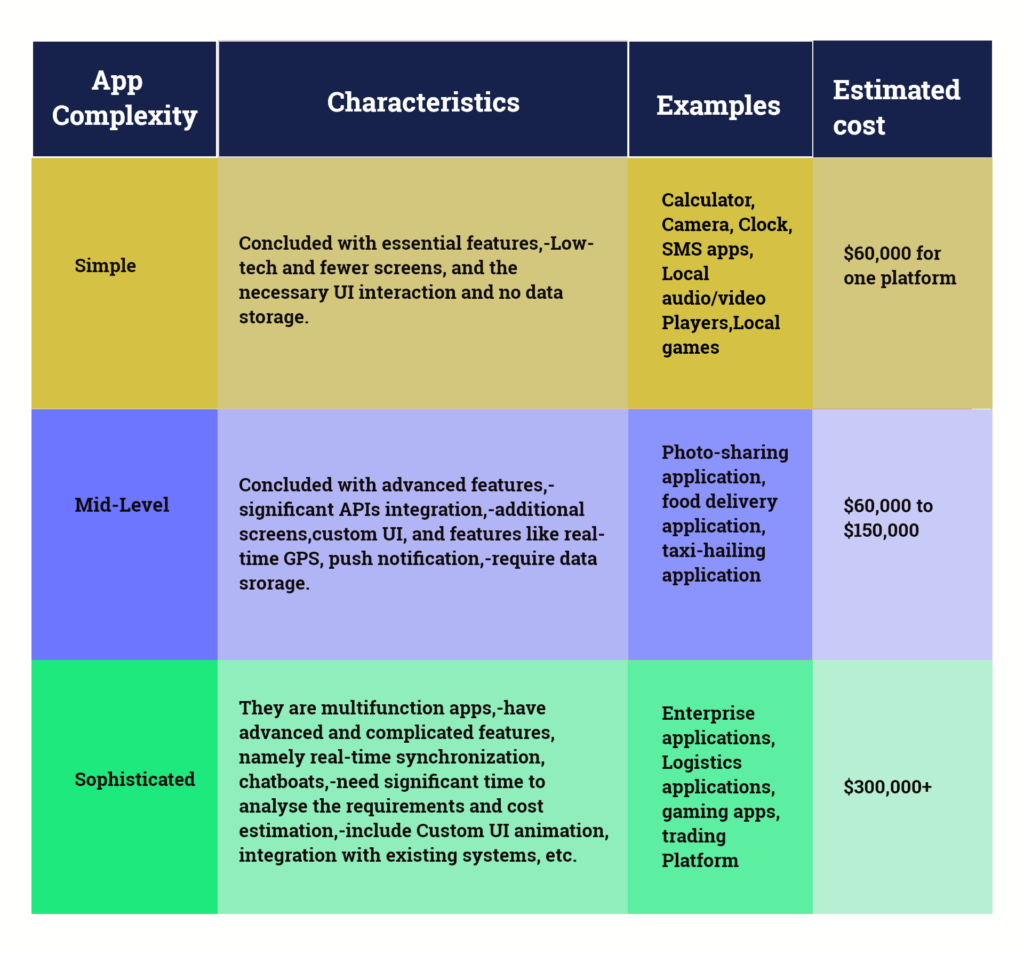
App development cost varies depending on the complexities as well. Developing an app with basic features doesn’t require maximum effort & cost comparatively. However, creating various features and integrations and maintaining complex business logic can extend the budget accordingly. Here, we list down three categories of apps and divide them based on their complexities:
Mobile App Development Cost Country-Wise
| Country | Average App Development Cost (per hour) | Notes |
| United States | $100 – $250 | High expertise, higher cost of living |
| United Kingdom | $80 – $180 | Skilled developers, relatively high costs |
| Canada | $80 – $150 | Quality services, slightly lower than the US |
| Australia | $90 – $160 | Strong tech proficiency, moderate pricing |
| Germany | $70 – $130 | Technologically advanced, moderate pricing |
| India | $20 – $80 | Lower labor costs, diverse price range |
| Ukraine | $25 – $70 | Growing tech hub, competitive pricing |
| Philippines | $18 – $50 | Lower costs, emerging tech talent |
| UAE | $40 – $100+ | Emerging market hub |
Cost variations across regions highlight how location influences development budgets, delivery models, and access to talent. Businesses often evaluate emerging markets alongside established hubs to balance quality and spend.
Mobile App Development Cost Based On The Type Of Apps
The type of app you are developing has a direct impact on the cost. If you are choosing a native app development approach and launching for Android users only. Then, the cost to develop an Android app will not be the same if you choose a cross-platform development approach for Android.
And if you are creating an app for iPads, then the iPad app development cost will have different price variations. The table below gives you an average cost estimation of app development for each app type.
| App Type | Average Development Cost | Notes |
| Android | $15,000 – $30,000 | Development for Android platform |
| iOS | $20,000 – $40,000 | Development for iOS platform |
| Native (per OS) | $30,000 – $80,000 | Custom development for each platform |
| Cross-platform | $20,000 – $60,000 | Development for multiple platforms simultaneously |
Mobile App Development Cost (App-Like Examples)
| App Like | Industry / Niche | Estimated Development Cost (USD) |
| App like Uber | On-Demand Ride Services | $80,000 – $200,000+ |
| App like Instagram | Social Media & Networking | $100,000 – $250,000+ |
| App like Amazon | E-commerce & Retail | $80,000 – $300,000+ |
| App like Spotify | Music Streaming | $100,000 – $250,000+ |
| App like WhatsApp | Messaging & Communication | $60,000 – $150,000+ |
| App like Netflix | Video Streaming | $120,000 – $300,000+ |
| App like Duolingo | EdTech / Learning | $60,000 – $180,000+ |
| App like TikTok | Short Video Content | $120,000 – $300,000+ |
| App like MyFitnessPal | Health & Fitness | $50,000 – $150,000+ |
| App like Zomato | Food Delivery & Aggregator | $70,000 – $180,000+ |
| App like Tinder | Online Dating | $60,000 – $120,000+ |
| App like Airbnb | Travel & Hospitality | $80,000 – $200,000+ |
| App like Robinhood | Fintech & Investment | $100,000 – $250,000+ |
| App like Slack | Team Collaboration / SaaS | $100,000 – $220,000+ |
App Development Cost Breakdown by Development Phase
| Development Phase | Description | Estimated Cost (USD) |
| Discovery & Planning | Research, tech consulting, feature listing | $1,000 – $5,000 |
| UI/UX Design | Wireframes, user flow, visual mockups | $2,000 – $7,000 |
| App Development | Frontend + backend coding (iOS/Android) | $10,000 – $35,000 |
| API & Integrations | Payment gateway, maps, third-party tools | $2,000 – $8,000 |
| Testing & QA | Manual & automated testing, bug fixes | $1,500 – $5,000 |
| Deployment | App Store/Play Store setup, configuration | $500 – $2,000 |
| Maintenance (Yearly) | Updates, minor fixes, tech support | $2,000 – $10,000 / year |
Total Estimated Cost (Basic to Mid-Level App): $17,000 – $60,000
What Should Be Included in an App Development Quote?
When comparing development companies, don’t compare only the final price. Check what each quote actually includes.
A detailed quote should clearly outline:
- Project discovery
- UI/UX design
- Frontend development
- Backend development
- API integrations
- QA and testing
- Project management
- Deployment
- Documentation
- Post-launch support
- Third-party costs
It should also explain the expected timeline, milestones, deliverables, payment structure, assumptions, and how additional requirements will be handled.
A $30,000 quote with limited deliverables may ultimately cost more than a $40,000 quote that includes a broader scope and stronger post-launch support.
Hidden App Development Costs You Should Know
By this stage, you’ve estimated the hours, chosen your tech stack, and maybe even shortlisted a mobile app development company to bring your vision to life. But wait, before you set your final budget, let’s talk about something most people miss: hidden costs.
These are the expenses that don’t usually show up in the first proposal, but they can quietly add up and take you by surprise if you’re not prepared. And we’re not talking about sneaky stuff, just things that are often overlooked. Now, let’s uncover them.
1. Third-Party Integrations & APIs
Planning to integrate services like Google Maps, Stripe, payment gateways, analytics tools, or chat support features into your app? Many third-party APIs operate on subscription-based or usage-based pricing models. While these integrations may appear simple initially, the actual implementation, backend connectivity, testing, and maintenance often increase the overall mobile app development cost by 10–20%, especially when the application involves complex workflows, real-time synchronization, or high user activity.
2. App Store Developer Accounts & Compliance Fees
To publish your app on platforms like Apple App Store or Google Play, you need a developer account:
- Apple: $99/year
- Google: One-time $25 fee
Besides this, you also have to add cost consideration if you need any legal compliance requirements like GDPR, HIPAA, or data privacy audits, especially if you’re targeting global markets. These aren’t “optional” anymore; they’re part of being legit. Especially if you’re working with a mobile app development company based in USA, compliance might already be baked into the process, but it’s good to ask and confirm.
3. Ongoing Testing & Optimization
Most people assume once the app is launched, it’s done. But here’s the truth: real users use your app in real (and weird) ways. That’s where post-launch testing, bug fixing, and usability improvements come in. Depending on the complexity, ongoing QA and optimization can cost you 5%–15% of your total build cost over the first 6–12 months. If you want to develop a mobile app that actually grows, you’ll need to continuously test, track, and tweak.
4. Backend Infrastructure & Hosting
Every app needs a reliable infrastructure to operate smoothly. This includes the backend, where all the business logic, databases, APIs, and user management systems are hosted. Platforms like Amazon Web Services, Firebase, or Google Cloud often start with low hosting costs, but expenses increase as user traffic, storage needs, and app activity grow. A business may initially spend around $50 per month, but scaling applications often push infrastructure costs beyond $500 monthly. Experienced teams from top app development companies usually help businesses forecast these scaling expenses early to avoid unexpected operational costs later.
5. App Marketing & User Acquisition
This is where many app creators fumble. You can build the best app in the world, but if no one knows about it, what’s the point? Marketing your app (ads, content, influencers, ASO, etc.) is not part of the usual quote from a mobile app development company, yet it’s essential. A good marketing budget should be at least 30–50% of your development budget, especially in competitive niches like health, fintech, or social.
6. Maintenance, Updates & Feature Enhancements
Even after launch, your app isn’t static. Tech evolves. User expectations shift. Platforms change their rules. Whether it’s updating for the latest iOS/Android version, fixing emerging bugs, or rolling out new features, maintenance is an ongoing cost. Expect to spend 10–20% of your initial development cost per year on this alone.
However, this cost may also vary depending on the location. For instance, if you partner with a reliable company that works in mobile app development in San Francisco or mobile app development New York, or internationally, they’ll often offer monthly or yearly maintenance packages. Make sure to ask about them early.
7. Security & Data Protection
Security isn’t just for fintech apps anymore. Even if you’re building a simple wellness tracker, user data needs to be safe. Encryption, secure logins, database protection, and regular audits all take time and money. Security measures might not show up in a “quick quote,” but they’re crucial if you want your app to be trusted.
Read Also : Mobile App Security: Ways to Avoid Data Leakage in Android Apps
How to Plan Your App Development Budget
Before development begins, create a budget around your product requirements rather than choosing a number first and trying to fit the project into it.
Define Your Business Goals
Start by identifying what the app needs to achieve. Your goals will influence the features, target users, technology requirements, and scope of the first release.
Prioritize Your Features
Separate your requirements into:
- Must-have features
- Important features
- Future enhancements
This makes it easier to determine what needs to be included in the initial development budget.
Decide Your MVP Scope
An MVP focuses on the core functionality required to launch and validate the product. You can add more advanced features after collecting feedback and understanding how users interact with the initial product.
Estimate Each Development Phase
Your budget should account for:
- Discovery and planning
- UI/UX design
- Frontend development
- Backend development
- Integrations
- Testing
- Deployment
- Post-launch support
Plan for Additional Expenses
Don’t limit your budget to development alone. Consider infrastructure, third-party services, security, app store costs, maintenance, and future updates.
Keep a Contingency
Requirements can change during development. Keeping some room in your budget can help accommodate unexpected technical requirements or approved scope changes without disrupting the project.
Useful Tips for Reducing App Development Cost
Building an app can feel like trying to buy a car with a hundred optional upgrades. While the base cost is reasonable, just adding features starts a snowball effect that gains momentum in design tweaks, backend services, and testing until the development becomes extremely costly.
At the same time, there are some effective ways that can help you reduce your mobile app development cost. Here are a few little things the smart founders, startups, and product leaders are doing to reduce the cost of app development without compromising quality.
1. Start with a Lean, Focused MVP
A very common mistake is trying to “make a perfect app” from day one. Instead, you want to go to market with the bare minimum features that solve the user’s biggest pain. These minimum features constitute an MVP, Minimal Viable Product, in essence, taking your product to market fast, creating a feedback loop, and growing your solution based on what you see in user behavior.
It makes sense either one way or another; it’s far less costly to see if an idea holds water by building an MVP than trying to build everything and then realizing it just will not work because the full build was messed up. The cost might also be affected if you choose to build a native app, then you have to work with either an Android or iOS application development company in USA, Europe, India or any other location you prefer.
2. Cross-Platform Development Could Work If Suited
When the app is hardly tied to any platform-centric features, cross-platform frameworks like Flutter and React Native can really act as a boon. Unlike building native apps for each platform, writing one codebase and deploying it everywhere slashes your development time and cost by up to 40%. This approach is being recommended by many mobile app development companies for startups and early-stage businesses desiring the quickest value from their investment.
Read Also : React Native VS Flutter: Which is Better For Your Business?
3. Prioritize Essential Features That Add Value
Every extra screen, animation, or “nice-to-have” feature adds hours of design and development time. And hours equal money. Here is a pragmatic approach to taking: make a list of all features you want, then assign scores as to:
- User impact
- Revenue potential
- Cost to implement
Keep only features that matter for your initial release. It’s not rejecting forever; it’s rejecting “for now” with intel selection. An expert company providing top-notch application maintenance services follows this method to decide which features will bring your vision to reality immediately.
4. Using Pre-Built Libraries and Open-Source Tools
There are many high-quality open-source libraries and UI components that can handle all the chores of forms, authentication, chats, or even entire dashboards. This ensures their reliability alongside saving precious development time.
Usually, behind the scenes, the best dev teams use those resources; this is just smart working, not cutting corners. And if you’re trying to build your own app with limited dev support, starting with pre-built UI kits and open-source frameworks makes your journey faster and lighter on the wallet.
5. Work With Outsourcing Development Team
You do not need to pay two-arm and two-leg prices in Silicon Valley for good-quality development. Many organizations today work with offshore teams or hybrid models (local project managers + global developers), where you get a local agency’s quality and communication at a fraction of the price with a global talent pool.
Mobile application development companies in Eastern Europe, India, and Southeast Asia offer top-class engineering talent at 50–70% of the Western rates without compromising quality. Just ensure you have given them due diligence (portfolio, reviews, communication style), and you are golden.
6. Stay Agile, Not Fixed-Scope
A fixed scope traditionally tends to promise more than it can deliver with bloated timelines and surprise costs, but agile development:
- Launches quickly
- Allows for improvements based on real data from users
- Allows adjustment of the scope from time to time firsthand
Most modern development teams now follow agile methodologies because they create better alignment between timelines, budget planning, and product value delivery. While comparing development partners, ask how they manage iterations, feature updates, and scalability during the development cycle. Teams offering adaptive delivery models, especially those experienced in hybrid app development services, help businesses optimize development investments while keeping the product ready for future growth.
Final Thoughts
Mobile app development is a significant investment for businesses, but the overall cost depends on much more than the development itself. App complexity, features, platform selection, UI/UX design, backend infrastructure, integrations, security, testing, and post-launch maintenance can all influence the final budget. A clear understanding of these factors helps businesses set realistic expectations before development begins.
If you are wondering how much it costs to develop an app in the upcoming years, the budget can range from around $15,000 for a basic MVP to $300,000+ for complex, enterprise-grade, or AI-powered applications. The right approach is to define your business goals, prioritize essential features, plan each development phase, and account for ongoing costs before finalizing the budget. Availing professional mobile app development services can help businesses plan the right technology approach, prioritize features, and build an application that fits both their budget and long-term objectives.
FAQs
Q1. How much does it cost to develop an app?
The cost to develop a mobile app typically ranges from $15,000 to $300,000+, depending on the app’s complexity, features, development approach, and technology stack. A basic MVP app may cost less, while enterprise-grade or AI-powered applications with advanced integrations and custom functionalities require a larger investment.
Q2. How long does it take to build a mobile app?
On average, mobile app development can take anywhere between 3 and 12 months, depending on the complexity of the project. A simple application with limited features may be completed within a few months, while complex apps with AI integrations, real-time features, and scalable backend infrastructure can take longer.
Q3. Why is mobile app development important for businesses?
Mobile app development helps businesses improve customer engagement, strengthen brand visibility, streamline operations, and create better user experiences. In near future, mobile apps will also play a major role in digital transformation, customer retention, automation, and revenue generation across industries.
Q4. What factors affect the overall app development cost?
Several factors influence the total cost of app development, including app complexity, features and functionalities, platform selection, UI/UX design, backend infrastructure, third-party integrations, security requirements, AI capabilities, development team expertise, and post-launch maintenance.
Q5. Which is more cost-effective: native or cross-platform app development?
Cross-platform app development is generally more cost-effective because it allows developers to build apps for both Android and iOS using a single codebase. However, native app development may offer better performance and customization for apps requiring advanced device-specific functionalities.
Discuss your project and request for proposal
SHARE
WRITTEN BY

Ishan Gupta
CEO & Founder
Ishan Gupta is a seasoned entrepreneur and CEO with extensive 10+ years of experience in business and mobile app development landscape. He believes that the right digital product allows companies to focus on what they do best, while technology handles the rest. With deep exposure to global markets, he understands what makes an app succeed. His approach translates business needs into clear product strategies, ensuring that every feature contributes to measurable ROI.
View All Articles